
Logic, Free Printables, Activities for Kids Jennifer Brooks Logic, Free Printables, Activities for Kids Jennifer Brooks

Why We Started Teaching Critical Thinking at Four

I still remember sitting at the kitchen table with my oldest, a little workbook open between us. I'd read a short sentence out loud, and he'd have to look at three or four pictures and circle the one that answered the question, or put an X through the one that didn't belong. It felt almost too simple to matter. But looking back now, after doing some version of this with all four of my kids, I think it was one of the best habits I built into our early years, and I didn't even fully realize what I was building at the time.
I still remember sitting at the kitchen table with my oldest, a little workbook open between us. I'd read a short sentence out loud, and he'd have to look at three or four pictures and circle the one that answered the question, or put an X through the one that didn't belong. It felt almost too simple to matter. But looking back now, after doing some version of this with all four of my kids, I think it was one of the best habits I built into our early years, and I didn't even fully realize what I was building at the time.

It Started With a Workbook I Loved

It was just a small early-childhood logic workbook I'd found years ago. I don't remember exactly how I came across it, but I used it over and over with each of my kids around age four or five: a short passage or prompt for the parent to read aloud, a handful of simple pictures, and one small task: circle the right one, cross out the one that's different, find the match.

It wasn't flashy. There were no bells or whistles, no app, no screen. Just a page, a pencil, and a few minutes of thinking out loud together. I actually went looking for it again last night, and it looks like it's been out of publication for a while now. That's part of why I started putting something similar together myself, more on that below.

Four Is Not Too Young

If you've spent any time around a four-year-old, you already know they are relentless question-askers. Why is the sky blue. Why do we have to wear shoes. Why does the cat sleep so much. That constant "why" isn't a phase to get through. It's a sign that their brains are primed for exactly this kind of thinking.

Researchers who study early brain development point to somewhere around ages three to five as a genuine window of opportunity for building the mental skills behind reasoning and self-control: the ability to hold an idea in mind, compare it to something else, and adjust your thinking when new information comes in. Some of the most detailed work on this comes out of Harvard's Center on the Developing Child, which describes this stretch of early childhood as a period of unusually fast growth for these skills, thanks to how quickly the brain is forming new connections at that age. Put simply: four-year-olds aren't too young to reason. In a lot of ways, four is close to the ideal age to start.

What It Actually Looks Like Day to Day

None of this requires a curriculum or a degree in child development. At four, "critical thinking" is really just:

  • Noticing patterns: "Which one of these doesn't belong?"

  • Cause and effect: "What do you think will happen if we pour all the water out?"

  • Simple comparisons: "Which one is bigger? Which one would float?"

  • Predicting and checking: asking your child to guess before you turn the page, read the answer, or finish the sentence.

The workbook I used just packaged all of that into a repeatable, few-minutes-a-day habit: I read, they looked, they marked an answer, we talked about why. That last part, the talking about why, is honestly the most important piece. The circling or the X is just the container for the conversation.

Why I Think It's Worth Starting Early

I didn't start this because I was trying to give my kids some kind of academic edge. I started because it was a nice quiet few minutes together, and it turned out to be a habit that stuck. By the time each of my kids hit kindergarten, they were used to being asked why do you think that and not just what's the answer, and I think that made them more comfortable with questions instead of rushing past them.

That's really the heart of it. Critical thinking at four isn't about getting the "right" answer fast. It's about building the muscle of pausing, looking closely, and reasoning it out, a muscle that gets so much harder to build once kids are older and more used to just wanting the answer handed to them.

What's Next

That workbook I loved isn't around anymore, which is part of what got me making something similar myself. I've got a few free printables ready to share now, with more on the way, all in that same read-aloud-and-circle-or-mark format. If you've got a four- or five-year-old at home, download them here to get you started.


Read More
Homeschooling, Activities for Kids Jennifer Brooks Homeschooling, Activities for Kids Jennifer Brooks

What's an Interest Box (and Why You Might Want a Few)

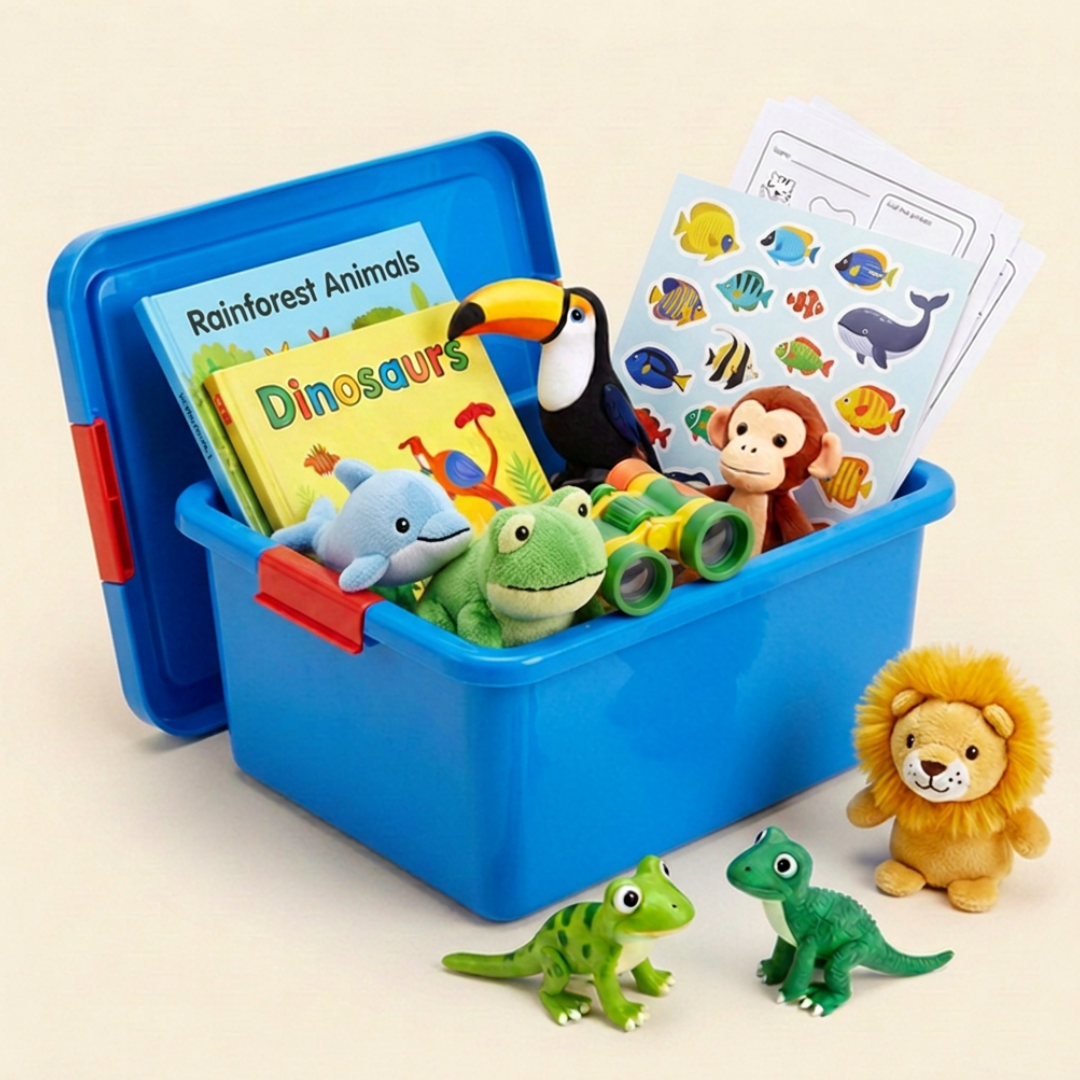
Picture this: it's late afternoon, you need to get dinner going, and you desperately need a genuinely focused hour without refereeing sibling fights. Enter the "Interest Box"—the ultimate tool to keep kids from 1st to 7th grade independently engaged using topics they already love.

Picture this: it's late afternoon, the littlest kids are done for the day, and you still need to get dinner going, sit with your oldest on math, and somehow not referee anything for the next 45 minutes.

That's the actual problem an interest box solves. Not "here's a cute activity," but "here's how I bought myself a genuinely focused half hour to an hour, more than once."

What it actually is

A bin, bigger than a shoebox, built around one topic your kid is already obsessed with. Not assigned. Obsessed. The kind of thing they'd read about on their own if you let them.

In my house, this covered kids from 1st grade through 5th at first, and later stretched all the way up to 7th grade for my youngest, once my older two had already moved into high school. The topics stayed the same kind of idea, I just adjusted the contents up in difficulty every year as they grew into it.

Inside, sorted by what your kids actually need at their actual levels are a mix of any of these:

  • Books at each kid's real reading level, not just the topic

  • Activity sheets scaled by age, mazes and simple matching for the littlest, something meatier for the oldest

  • Theme-specific extras, not general craft supplies (those live in a separate box, more on that below)

  • Imaginative play props (a magnetic scene board, animal puppets, anything that lets a kid tell their own story instead of just consuming information)

  • One big collaborative visual project that builds over time, a mural on butcher paper, a scene they add to piece by piece

  • Open-ended research prompts for your oldest kids, no grading, no assignment, just "go find out why" and see what they bring back

The rules that kept it running

A few ground rules made this sustainable instead of becoming one more mess to manage:

Everything goes back in the box when you're done, except whatever printables actually got used up. Doesn't matter how big the mural got or how far the puppets wandered, if it came out of the box, it goes back in the box.

A separate supply box lived alongside the themed one, always out, never packed away: plain paper, construction paper, paper scraps, crayons, markers, pencils, erasers, glue sticks, and kid-safe scissors. That meant I never had to restock basic supplies into every single themed box, just whatever was actually specific to that topic.

"Clean up" had a real trigger attached to it, not a vague command. It usually meant we were moving on to something concrete: clearing the table for lunch, starting the next subject, whatever came next. Kids follow an actual transition a lot better than an arbitrary "okay, time to stop."

Why it actually works

This isn't a parenting trick I stumbled into once. It's the same principle my whole teaching career has been built on, all the way back to my first years teaching in private schools, straight through to now: build the unit around what the kid already cares about, instead of handing them a generic curriculum and hoping it lands. An interest box is that exact same idea, just shrunk down to fit a rainy afternoon instead of a sixteen-week semester.

Every kid engages at their own level, at the same time, without you running three separate lessons. You sit with them just long enough for them to get the hang of it, then they run with it. And here's the part that keeps it working long-term: revamp the box every so often. Swap out half the contents, add something new, and a box your kids have already seen suddenly feels brand new again.

Some of the boxes that have actually existed in my house

Butterflies. Horses. Castles. Dinosaurs, which needed two boxes because there was simply too much good stuff. The ocean, and later a box that narrowed in specifically on whales. Rainforest. Australia, focused mostly on wildlife, koalas, kangaroos, and everything in between.

None of these were school assignments. They were just whatever my kids were into that month, given somewhere to land.

If this is something you want to try, I'll be posting themed versions of these boxes over time: book lists by grade level, links to other people's free printables, and a few of my own worksheets. I'm also put together an Interest Box Planner, a printable to help you track topics as they come up, jot down what to look for at the thrift store or dollar store, and keep a running list of books to look for before the next box comes together.

Click here to download the Interest Box Planner

Read More