Why We Started Teaching Critical Thinking at Four
I still remember sitting at the kitchen table with my oldest, a little workbook open between us. I'd read a short sentence out loud, and he'd have to look at three or four pictures and circle the one that answered the question, or put an X through the one that didn't belong. It felt almost too simple to matter. But looking back now, after doing some version of this with all four of my kids, I think it was one of the best habits I built into our early years, and I didn't even fully realize what I was building at the time.
It Started With a Workbook I Loved
It was just a small early-childhood logic workbook I'd found years ago. I don't remember exactly how I came across it, but I used it over and over with each of my kids around age four or five: a short passage or prompt for the parent to read aloud, a handful of simple pictures, and one small task: circle the right one, cross out the one that's different, find the match.
It wasn't flashy. There were no bells or whistles, no app, no screen. Just a page, a pencil, and a few minutes of thinking out loud together. I actually went looking for it again last night, and it looks like it's been out of publication for a while now. That's part of why I started putting something similar together myself, more on that below.
Four Is Not Too Young
If you've spent any time around a four-year-old, you already know they are relentless question-askers. Why is the sky blue. Why do we have to wear shoes. Why does the cat sleep so much. That constant "why" isn't a phase to get through. It's a sign that their brains are primed for exactly this kind of thinking.
Researchers who study early brain development point to somewhere around ages three to five as a genuine window of opportunity for building the mental skills behind reasoning and self-control: the ability to hold an idea in mind, compare it to something else, and adjust your thinking when new information comes in. Some of the most detailed work on this comes out of Harvard's Center on the Developing Child, which describes this stretch of early childhood as a period of unusually fast growth for these skills, thanks to how quickly the brain is forming new connections at that age. Put simply: four-year-olds aren't too young to reason. In a lot of ways, four is close to the ideal age to start.
What It Actually Looks Like Day to Day
None of this requires a curriculum or a degree in child development. At four, "critical thinking" is really just:
Noticing patterns: "Which one of these doesn't belong?"
Cause and effect: "What do you think will happen if we pour all the water out?"
Simple comparisons: "Which one is bigger? Which one would float?"
Predicting and checking: asking your child to guess before you turn the page, read the answer, or finish the sentence.
The workbook I used just packaged all of that into a repeatable, few-minutes-a-day habit: I read, they looked, they marked an answer, we talked about why. That last part, the talking about why, is honestly the most important piece. The circling or the X is just the container for the conversation.
Why I Think It's Worth Starting Early
I didn't start this because I was trying to give my kids some kind of academic edge. I started because it was a nice quiet few minutes together, and it turned out to be a habit that stuck. By the time each of my kids hit kindergarten, they were used to being asked why do you think that and not just what's the answer, and I think that made them more comfortable with questions instead of rushing past them.
That's really the heart of it. Critical thinking at four isn't about getting the "right" answer fast. It's about building the muscle of pausing, looking closely, and reasoning it out, a muscle that gets so much harder to build once kids are older and more used to just wanting the answer handed to them.
What's Next
That workbook I loved isn't around anymore, which is part of what got me making something similar myself. I've got a few free printables ready to share now, with more on the way, all in that same read-aloud-and-circle-or-mark format. If you've got a four- or five-year-old at home, download them here to get you started.
What's an Interest Box (and Why You Might Want a Few)
Picture this: it's late afternoon, you need to get dinner going, and you desperately need a genuinely focused hour without refereeing sibling fights. Enter the "Interest Box"—the ultimate tool to keep kids from 1st to 7th grade independently engaged using topics they already love.

Picture this: it's late afternoon, the littlest kids are done for the day, and you still need to get dinner going, sit with your oldest on math, and somehow not referee anything for the next 45 minutes.
That's the actual problem an interest box solves. Not "here's a cute activity," but "here's how I bought myself a genuinely focused half hour to an hour, more than once."
What it actually is
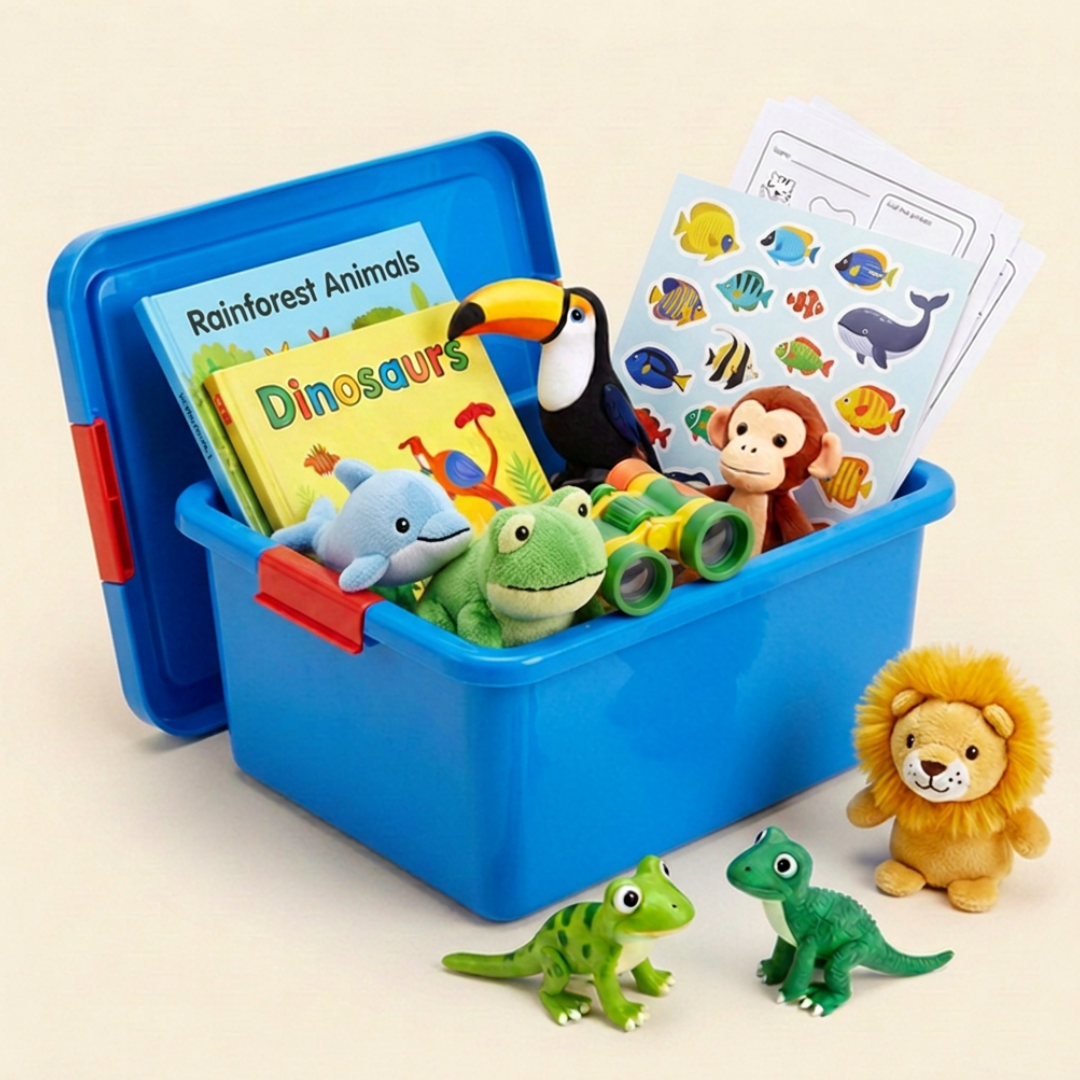
A bin, bigger than a shoebox, built around one topic your kid is already obsessed with. Not assigned. Obsessed. The kind of thing they'd read about on their own if you let them.
In my house, this covered kids from 1st grade through 5th at first, and later stretched all the way up to 7th grade for my youngest, once my older two had already moved into high school. The topics stayed the same kind of idea, I just adjusted the contents up in difficulty every year as they grew into it.
Inside, sorted by what your kids actually need at their actual levels are a mix of any of these:
Books at each kid's real reading level, not just the topic
Activity sheets scaled by age, mazes and simple matching for the littlest, something meatier for the oldest
Theme-specific extras, not general craft supplies (those live in a separate box, more on that below)
Imaginative play props (a magnetic scene board, animal puppets, anything that lets a kid tell their own story instead of just consuming information)
One big collaborative visual project that builds over time, a mural on butcher paper, a scene they add to piece by piece
Open-ended research prompts for your oldest kids, no grading, no assignment, just "go find out why" and see what they bring back
The rules that kept it running
A few ground rules made this sustainable instead of becoming one more mess to manage:
Everything goes back in the box when you're done, except whatever printables actually got used up. Doesn't matter how big the mural got or how far the puppets wandered, if it came out of the box, it goes back in the box.
A separate supply box lived alongside the themed one, always out, never packed away: plain paper, construction paper, paper scraps, crayons, markers, pencils, erasers, glue sticks, and kid-safe scissors. That meant I never had to restock basic supplies into every single themed box, just whatever was actually specific to that topic.
"Clean up" had a real trigger attached to it, not a vague command. It usually meant we were moving on to something concrete: clearing the table for lunch, starting the next subject, whatever came next. Kids follow an actual transition a lot better than an arbitrary "okay, time to stop."
Why it actually works
This isn't a parenting trick I stumbled into once. It's the same principle my whole teaching career has been built on, all the way back to my first years teaching in private schools, straight through to now: build the unit around what the kid already cares about, instead of handing them a generic curriculum and hoping it lands. An interest box is that exact same idea, just shrunk down to fit a rainy afternoon instead of a sixteen-week semester.
Every kid engages at their own level, at the same time, without you running three separate lessons. You sit with them just long enough for them to get the hang of it, then they run with it. And here's the part that keeps it working long-term: revamp the box every so often. Swap out half the contents, add something new, and a box your kids have already seen suddenly feels brand new again.
Some of the boxes that have actually existed in my house
Butterflies. Horses. Castles. Dinosaurs, which needed two boxes because there was simply too much good stuff. The ocean, and later a box that narrowed in specifically on whales. Rainforest. Australia, focused mostly on wildlife, koalas, kangaroos, and everything in between.
None of these were school assignments. They were just whatever my kids were into that month, given somewhere to land.
If this is something you want to try, I'll be posting themed versions of these boxes over time: book lists by grade level, links to other people's free printables, and a few of my own worksheets. I'm also put together an Interest Box Planner, a printable to help you track topics as they come up, jot down what to look for at the thrift store or dollar store, and keep a running list of books to look for before the next box comes together.
How Context-Based Learning Shapes Every Class I Teach: One Deliberate Exception Included
In my last post I talked about why context-based learning works. What the research says, why the human brain responds to problems differently than to facts in isolation, and why the entry point into a subject matters as much as the content itself.
Here is what that looks like in practice across every class I teach. And where I deliberately broke my own rule, and why.

In my last post I talked about why context-based learning works. What the research says, why the human brain responds to problems differently than to facts in isolation, and why the entry point into a subject matters as much as the content itself.
Here is what that looks like in practice across every class I teach. And where I deliberately broke my own rule, and why.
This Is What Most of My Classes Do
In Science Through Stories, I use novels and films, selected for narrative quality, not because they happen to mention photosynthesis, as the entry point for real science. Ray Bradbury's description of a sunrise on Venus in All Summer in a Day is a nearly perfect account of Rayleigh scattering. The City of Ember's failing generator is a real lesson in electrical grids and hydroelectric power. WALL-E's Earth is an entry point for ecology, chemistry, and atmospheric science.
The story is what makes the student want the science. That matters.
In the Forensic Science series, every case is built around a genuine forensic technique, fingerprint analysis, DNA profiling, blood spatter physics, toxicology, and the technique is introduced because the case requires it. Students do not learn about surface tension because it is on the curriculum. They learn it because they need it to figure out where something happened in a mall food court.
In the applied mathematics classes, real-world situations drive the math. Not "solve for x" but "here is a structural problem. What happens when one variable changes?" The math is the tool. The problem is the reason to pick it up.
The Exception: Engineering 101
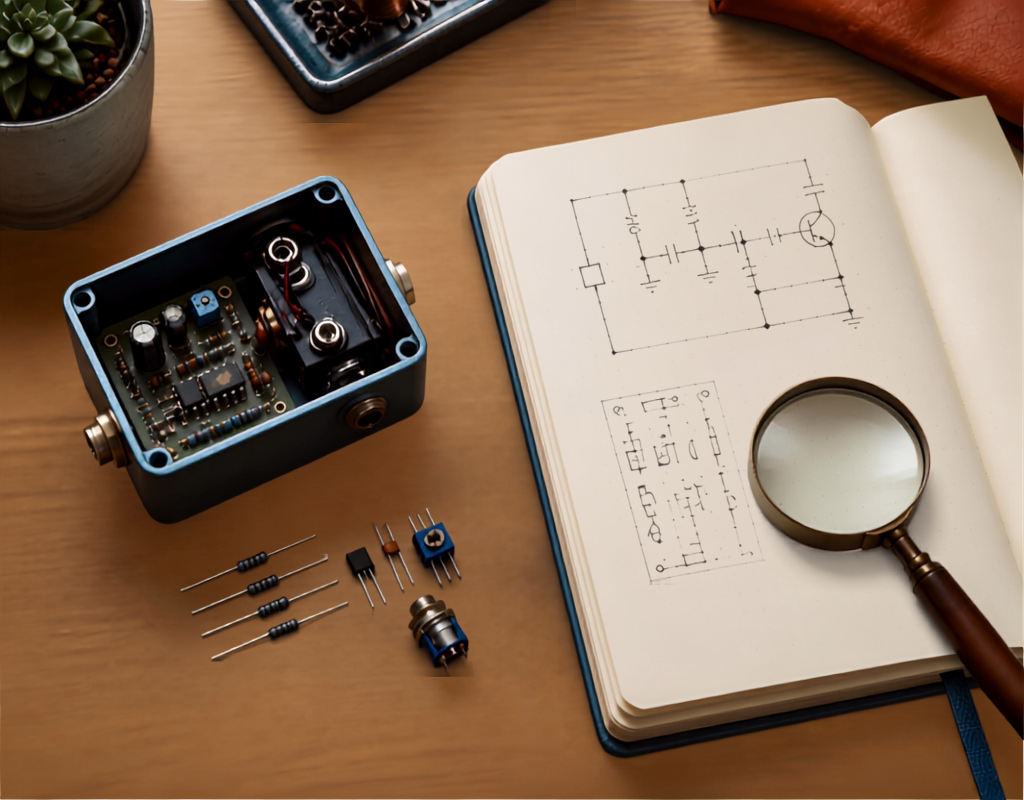
Engineering 101 is 32 weeks of straight college-prep rigor: calculus, statics, differential equations, circuit analysis, thermodynamics, fluid dynamics. There is no narrative hook. No case to solve.
The content IS the hook because the students who belong in this class are the ones who want to know what the first two years of an engineering program actually look like before they commit to that path.
For that student, transparency IS the pedagogy. Showing them the real thing. Not a simplified version, not an introduction to the idea of engineering, but the actual content at the actual level, is the most useful thing I can do. If they love it, they arrive at college prepared and ahead. If they discover it is not for them, they find that out while the stakes are low, not after paying a semester of tuition.
Both outcomes serve the student.
The boy who ended up in forensic accounting came through my forensic science class first. But if he had walked into Engineering 101 and found that the quantitative rigor energized him, even without a mystery attached, he might have found a different door to the same destination. Different approach. Same goal: give the student enough of the real thing that they can figure out who they actually are.
But Is It Rigorous?
This is the question I get from parents who worry that engaging = easy, or that a mystery format means the science is dumbed down. The answer is no.
The fingerprint class covers the statistics of the 12-point minutiae standard, why that threshold exists, what the probability of a false match is at different point counts, and why a 7-point partial print is inconclusive. Students calculate those probabilities themselves.
The blood spatter class covers the formula sin(θ) = width ÷ length, applies it to actual measurements, and uses the results to reconstruct event sequences geometrically. Students use trigonometry.
The DNA class covers PCR amplification, STR loci, population statistics, and familial matching percentages. Students compare simplified DNA profiles and evaluate what different confidence levels mean for court admissibility.
The toxicology class covers colorimetric screening vs. GC-MS confirmation, how gas chromatography separates compounds by retention time, and how mass spectrometry produces a molecular fragmentation pattern that functions as a chemical fingerprint.
These are the real concepts, taught in a context that makes students want to understand them.
The NGSS standards met across the forensic science series include MS-PS1.A, MS-PS1.B, MS-PS2.A, MS-LS1.A, MS-LS3.A, and MS-LS3.B, plus Science and Engineering Practices SEP 4, SEP 7, and SEP 8 across every class. Documentation is available for charter school and co-op funding requests.
Where to Start
If you are curious about whether this approach works for your kid, the lowest-stakes entry point is one two-week forensic science mini-course. Each case is self-contained. No prior knowledge required. Just one mystery, one forensic technique, and eight days of content.
If your child is younger or prefers stories to mysteries, the Science Through Stories series starts with picture books for the youngest learners and moves through novels and films for upper elementary and middle school.
If your teenager is considering engineering, or thinks they might not be interested, and you want to find out for certain, Engineering 101 is the class that answers that question before the tuition bill arrives.
The common thread across all of it: give the student enough of the real thing that they can figure out who they actually are. The student who says they hate science sometimes turns out to be the one who stays after class to ask one more question.
That kid is everywhere. They just need the right door.
Why Your Kid Might Learn More Science From a Mystery Than a Textbook
Almost no child actually hates science—what they hate is science disconnected from anything they care about. If your student gets glazed eyes when asked "what is surface tension?" but tunes in when asked how forensic science solves a mystery, here is why their brain is wired for problem-solving over abstract facts.

I have been teaching science for over twenty years. I have taught it in private schools, in homeschool co-ops, in 4-H programs, and online. I have taught kids who loved science and kids who were convinced they hated it. I have taught kids who were told they were not science people.
Let me tell you about two of them.
The first was a girl who joined my middle school chemistry class. Her mom warned me upfront: "She hates science. I just want you to know." She was polite. She did the work.
By the end of the semester, she was cornering family members at gatherings to tell them chemistry facts. Not because I asked her to. Because she had found something that clicked and she wanted to share it. She did not become a chemist . She went on to attend a college preparatory high school and found her path there. But something shifted that semester in the way she thoguht about science.
The second was a boy who took my forensic science course. He was good at math, really good, and he knew it. When I asked him what he wanted to do with it, he said: "Not engineering. That sounds boring. Not accounting either. That sounds even more boring." He ended up in forensic accounting.
He found a field that did not exist for him before he started asking questions about how evidence works and how numbers tell stories about real problems. He did not become what he expected to become. He became something that fit the way his brain actually worked.
Here is what I have learned from twenty years of watching this happen: almost no child actually hates science. What they hate is science disconnected from anything they care about.
The question "what is surface tension?" produces glazed eyes. The question "why does a drop of blood form a perfect sphere when it falls through the air — and what does that sphere tell you about where something happened in a room?" produces something completely different.
Same concept. Completely different engagement. Because one question has stakes and one does not.
This is not a gimmick. It is the way learning actually works.
What the Research Says
Educational researchers have a term for this: contextual learning. The idea is simple — students learn and retain information more effectively when it is embedded in a meaningful context rather than presented in isolation.
John Dewey argued for this in the early 1900s. Jerome Bruner's work on narrative and cognition in the 1960s showed that the human brain is fundamentally a story-processing machine. We understand and remember information better when it comes embedded in a narrative structure. More recently, researchers studying STEM education have consistently found that problem-based learning, where students encounter a real problem first, then acquire the knowledge needed to solve it, produces stronger conceptual understanding and longer retention than traditional instruction.
None of this is controversial in educational research. It is, however, still underrepresented in standard curricula — because textbooks are easier to standardize than mysteries.
The Problem With "Just Take Biology"
A standard biology class covers cells, genetics, ecosystems, evolution, and human body systems. These are genuinely important topics. I am not saying never take biology.
What I am saying is that a biology class that covers DNA replication in Chapter 7 between photosynthesis and the cell cycle is asking students to care about something in the abstract, to trust that it will matter someday, without giving them a reason to care about it today.
Some students can do that. Many cannot. And the ones who cannot are not failing because they lack intelligence or curiosity. They are failing because the human brain is not well-designed for learning things in the abstract. It is well-designed for solving problems.
Here is what happens when you teach DNA in the context of forensic investigation:
The student encounters a problem first: a child is found at a bus station with no memory of her name. How do investigators identify her?
That question creates what researchers call cognitive readiness to learn — the brain is primed to receive information because it has a reason to want it. When the lesson then explains what STR loci are, how PCR amplification works, and why 20 matching loci produces a 1-in-1-quadrillion probability, the student is not learning facts in isolation. They are acquiring tools to answer a question they already care about.
The retention difference is significant. The engagement difference is visible in real time.
So what does this actually look like in a real classroom? To see how this philosophy shapes every class I teach, and one notable exception, continue reading here.
Could You Actually Grow Potatoes on Mars?
If your child got stranded on Mars tomorrow with a bag of potatoes, could they actually grow dinner in the dirt outside their window? We look at what Hollywood got right, what it got dangerously wrong, and how real scientists are solving the Mars food problem.
If you got stranded on Mars tomorrow and someone handed you a bag of potatoes, could you actually grow them in the dirt outside your window?
That's the setup in "The Martian" by Andy Weir. If you've seen the movie, you know the plan: Mars dirt, plus human waste, plus water, equals dinner. It looks almost easy on screen.
It is not easy. Mars soil has a chemistry problem that never even comes up in the movie, and once you know what it is, you won't watch that scene the same way again.
Here's why this isn't just a fun "what if," though. Astronauts on a normal mission eat somewhere around 1.7 to 2.5 kilograms of food a day. Stretch that across a multi-year round trip to Mars and NASA's own estimates put the food alone at close to 3,000 kilograms, per person, if every single bite has to launch from Earth. Multiply that by an actual crew and you've got a rocket that's mostly groceries.
That's the real problem sitting underneath Watney's potato plan. It was never really about potatoes. It's about mass. Every kilogram of food you don't have to launch is a kilogram you can spend on fuel, equipment, or just getting people home safely. Growing food once you get there isn't a nice bonus for a Mars mission, it's one of the only ways a mission like that becomes possible at all.
So did the movie actually solve that problem? Sort of. It got the goal right and the method very wrong.
In this class, my co-teaching robot Watson and I dig into what "The Martian" got right, what it got very wrong, and what real researchers are actually doing right now to solve the Mars food problem for real. (Haven't met Watson yet? He's a real offline robot I built myself. Long story, worth its own post.)
You'll walk away knowing:
What's actually toxic about Martian soil, and why it's not what most people guess
Why "human waste as fertilizer" is half right and half genuinely risky
What plants actually need to grow, and why soil might not even be the important part
What real scientists are testing on Earth right now for future Mars missions
This one's a single async class, 25 to 30 minutes, ages 12 to 15.
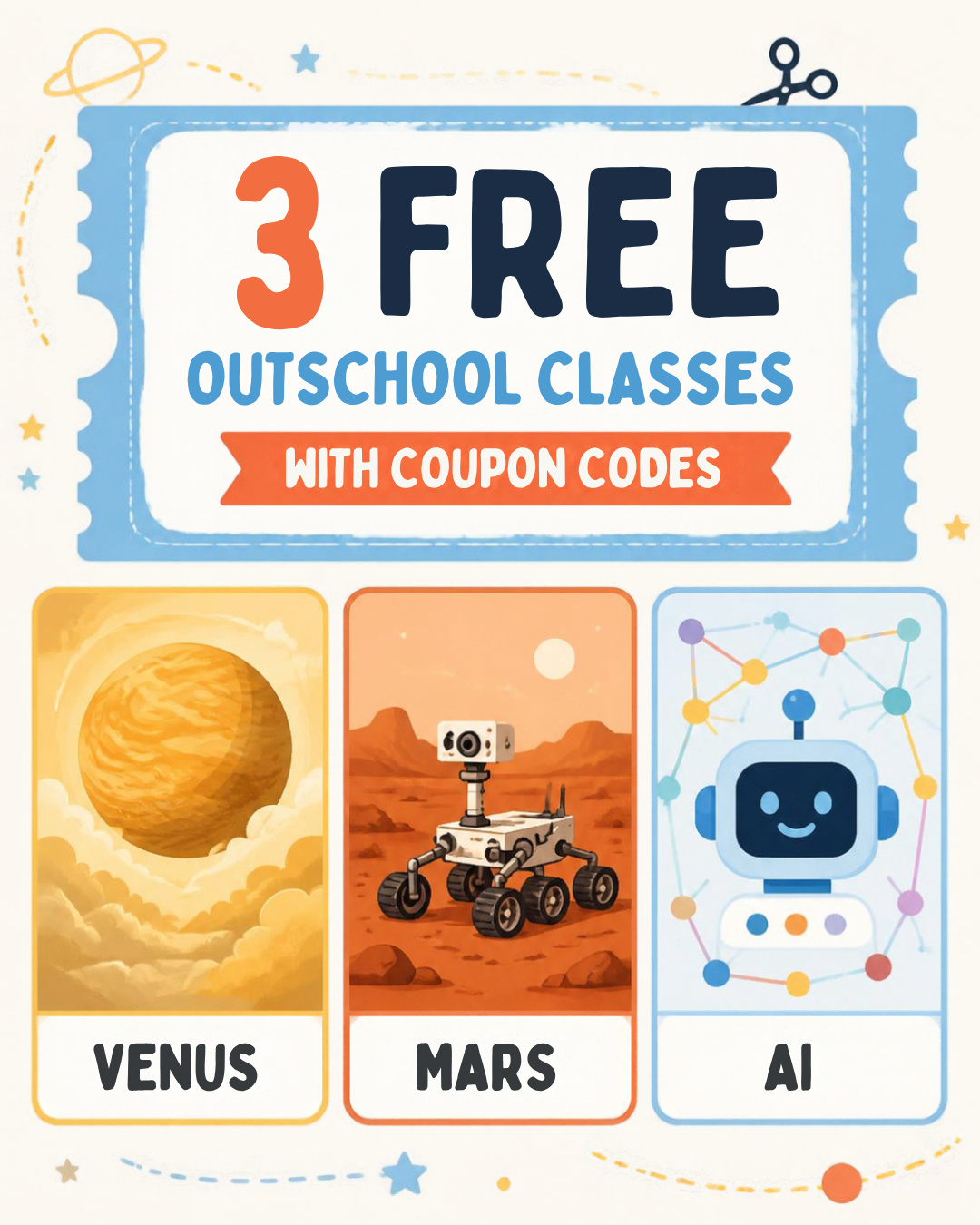
Grab it here with code JBLOG7510 for a free seat while it's active.
Not ready to enroll yet? Try this first.
You're the first person sent to live on the Moon or Mars, and it's your job to design a greenhouse that can feed everyone there. Draw it, then think through what you'd need to bring from Earth to build it, and what you'd grow to keep everyone healthy. No right answers required, just curiosity. Download here for free.
What Is AI, Actually? (And Why I Use It In My Classroom)
“AI" is everywhere right now. Some schools are banning it. Some companies are requiring it. Here is what it actually means for your kids.
"AI" is everywhere right now. Some schools are banning it. Some companies are requiring it. Your kid has probably already used it, whether you knew it or not. And somehow, almost nobody stops to explain what the term actually means.
So let's do that first, before getting to what it means for your kids.
"AI" is mostly a marketing word
Here's my honest opinion, and it's more than a nitpick about semantics: "artificial intelligence" is a misnomer. Look at what the word "intelligence" actually means and you'll see why.
The dictionary definition is the ability to learn or understand things, or to deal with new and difficult situations, reason. There's also a specific legal sense of "intelligent" worth knowing: having an understanding of the nature and consequences of an act or decision, which is the exact standard used in Miranda rights cases, a valid waiver has to be "knowing and intelligent."
Consequences. That's the part that matters here. When we call a person intelligent, we don't just mean they're good at logic. We mean something bigger: can they reason forward, can they weigh how a choice affects someone else, can they sense that telling a kid something a certain way is going to land differently than telling an adult the same thing. That's not pure logic. That's judgment, and real judgment usually has an emotional and social piece built into it.
Current AI systems don't do any of that. They don't weigh how a sentence might make your kid feel. They don't have any sense of consequence for your neighbor, your family, or anyone else. What they actually do is predict likely patterns from data, extremely well, but that's a much narrower thing than what "intelligence" has always meant when we use the word about a person. Borrowing that word for these systems imports a promise the technology doesn't actually keep.
Two terms that describe what's actually happening:
Machine learning. A system that gets trained on a lot of data and learns to find patterns in it. Your email spam filter, the "you might also like" suggestions on a shopping site, your phone's autocorrect, that's machine learning. Nothing mystical about it, just statistics at scale.
Large language models. A large language model is trained on enormous amounts of text and learns to predict what word is likely to come next, over and over, until it can produce fluent, humanlike writing. It's remarkably good at sounding like it understands. Whether that counts as real understanding is a genuine, ongoing debate even among the researchers who build these things. What isn't up for debate is that these systems are not conscious, do not have beliefs, and can be confidently, fluently wrong.
That last part matters more than anything else in this post.
Why this isn't going away, so ignoring it isn't a strategy
Some schools have banned AI tools outright. At the same time, plenty of companies are actively building it into how they expect future employees to work. Your kids are going to grow up in a world where this technology exists either way.
The most useful thing you can do isn't shielding them from it or handing it over unsupervised. It's teaching them, early, what it actually is, what it's genuinely good at, where it falls apart, and how to use it as a tool, not a substitute for their own judgment. Some kids will even want to learn how these systems get built in the first place. That's a door worth leaving open too.
The part that actually worries me about AI in kids' education right now
A lot of homework and tutoring sites have quietly swapped in AI where a human tutor used to be. It answers the question, your kid copies it down, done. The problem is straightforward: these answers aren't always correct, and a system that sounds confident while being wrong is a genuinely dangerous combination for a kid who doesn't yet have the instinct to double-check. Without a human somewhere in that loop, wrong answers get absorbed just as easily as right ones, and confidently.
Why Watson is built differently
Watson, my co-teaching robot, uses the exact same underlying kind of technology, a large language model. He only knows what I've actually taught him. Because of how large language models work, he sometimes takes what he does know and tries to predict or extrapolate an answer from it, and every so often that statistical leap lands wrong, the AI equivalent of putting two and two together and landing on five. That's not a flaw I could have coded away, it's just what this kind of technology does. My job is to catch it, correct him, and feed him the right information going forward, the same way I would with any student.
He asks questions instead of announcing conclusions. He checks with me before he speaks. When he's uncertain, he says he's uncertain. That's not a cute personality quirk, it's the actual point. Kids watching Watson learn what a healthy relationship with AI actually looks like: curious, useful, and never fully trusted without a human checking the work.
He also runs entirely offline, on a small computer, with no connection to the internet and no data going anywhere. Nothing about how he works is a black box. I built him myself, and if your kids are curious how, that's a conversation we're happy to have in class.
If you want to actually meet him, here's his page. And if you want to see him in action, check out my current classes available.