Math Jennifer Brooks Math Jennifer Brooks

Your Kid Loves Cooking? They're Already Doing Pre-Algebra

If your student spends more time in the kitchen than at a desk, good news: they've been practicing pre-algebra the whole time without knowing it.

If your student spends more time in the kitchen than at a desk, good news: they've been practicing pre-algebra the whole time without knowing it.

Recipes are ratio and proportion problems wearing an apron. Every time a recipe gets scaled up for a bigger group or scaled down for a smaller one, that's a proportion. Every time a recipe gets halved and a fraction needs adjusting, that's fraction operations. Every time a grocery store sale changes a price, that's percent. Kids who cook have already built number sense for all of this. They just haven't been shown that it's math yet.

This is exactly why my pre-algebra class rotates through real contexts instead of staying locked into one theme all year. A kid who lights up over a recipe card is going to engage with a ratio problem framed as a recipe a lot faster than the same problem framed as "solve for x."

Here's a free sample worksheet with six cooking-based pre-algebra problems, spanning ratios, proportions, fractions, and percent. It's a taste of the range covered across the year, not the full homework set your student would get in class.
If this is the kind of math your kid could actually get excited about, that's the whole point of how
this class is built.

Read More
Math Jennifer Brooks Math Jennifer Brooks

Why Word Problems Matter More Than the Answer

Solving for x was never actually the hard part. A student can memorize "isolate the variable" in ten minutes. What takes years to build is the skill of looking at a real situation — a grocery receipt, a recipe, a stat sheet — and recognizing which math it's even asking for. That translation step is the skill that gets skipped when kids only ever practice equations someone already set up for them.
Parents sometimes ask why I spend so much class time on word problems instead of just drilling the mechanics. Solving for x is solving for x. Why not just teach the steps and move on?

Here's the thing. Solving for x was never actually the hard part.

A student can memorize "isolate the variable, do the opposite operation" in about ten minutes. What takes years to build is the skill of looking at a real situation and recognizing which math it's asking for in the first place. Nobody hands a kid an equation in real life. They hand them a grocery receipt, a recipe that needs to feed twice as many people, a sports stat that changed over a season. The math is buried inside the situation, and the student has to find it before they can solve anything.

That translation step, from real situation to math problem, is the actual skill. It's also the one that gets skipped when a class only ever hands students equations that are already set up and ready to solve.

There's a second piece this builds too: knowing when an answer is wrong just by looking at it. A student who's only ever practiced abstract equations has no instinct for whether their answer makes sense. A student who's worked through word problems knows that if they calculate a car traveling at negative 40 miles per hour, or a recipe that needs negative 3 cups of flour, something went wrong upstream, even before they check their work line by line. That instinct, catching a nonsense answer before it leaves the page, is something most math classes never teach at all.

There's also a simpler reason. Kids who don't think of themselves as "math people" usually don't dislike math itself. They dislike math that has no reason to exist. A percent problem about a discount at a store a kid actually shops at lands differently than the same percent problem with no context. The math is identical. The willingness to engage with it isn't.

None of this means the mechanics don't matter. A student absolutely needs to know how to solve an equation cleanly and correctly. But mechanics without the translation skill is a student who can execute a procedure and nothing else, and that's a fragile kind of knowing. It falls apart the moment the problem doesn't look exactly like the practice set.

Word problems, done early and done often, are how you build the sturdier version of that skill instead.

Over the next few days, I’ll be posting real world examples, along with free worksheets so you can try this out for yourself. If you would like to be alerted when those are posted, add your email address here.

Read More
Math, Online Classes, Homeschooling Jennifer Brooks Math, Online Classes, Homeschooling Jennifer Brooks

Why This Pre-Algebra Class Is Different

A locked strongbox. A note that raises more questions than it answers. A ledger full of numbers that don't add up, yet. This is how Fox Hollow Files begins, and it's the same case your student spends the whole year solving.

Most pre-algebra classes start the same way. Open to page one. Here's a definition. Here are twenty practice problems. Repeat for a year.

Kids can get through that. Plenty of them pass tests doing exactly that. But ask a student six months later why you cross-multiply, or what a percent of change actually is, and you'll usually get a blank look. They learned the steps. They never learned what the steps were for.

This class works differently, and not in a "we use real-world examples sometimes" way. The entire year is one continuous mystery.

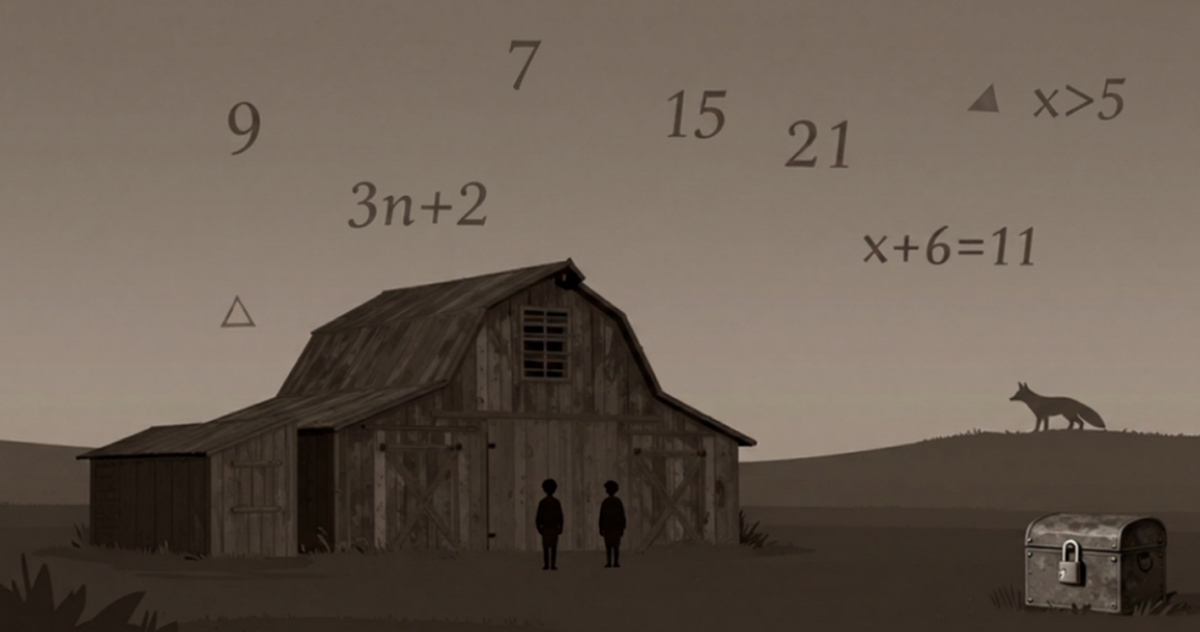
Here's the premise. Two cousins, Maya and Eli, inherit their grandfather's old farm for the school year. He's left them a locked strongbox and one note inside: "Everything you need to know is already on this farm. You just have to do the work to find it." Every week, they work through another piece of the property, an old general store ledger, a hidden dirt racetrack, decades of weather records, a workshop full of half-finished projects, and every part of it only makes sense once you do the actual math behind it.

The math isn't decoration on top of the story. It's the tool the story needs. Solving an equation isn't a worksheet exercise, it's how Maya figures out what the ledger's cryptic shorthand actually means. Ratios aren't an abstract unit, they're how the cousins figure out if the old farm's crop rotation still makes sense.

My co-teacher Watson sits in on every class too. He's a real offline robot I built myself, and he works through the case right alongside the students, asking the questions they're already thinking and occasionally getting there a step behind everyone else.

Classes run live, twice a week, 40 minutes each, with short posts in between: worked examples to reinforce what was just taught, and a second post that mixes review, a harder challenge problem, and something just for fun, a puzzle, a hands-on activity, a piece of math history. Chapter tests happen every few weeks, print at home, no new apps or logins required.

Here's a small piece of how it opens.

The attic hadn't been touched in years. A single shaft of window light cut across stacked boxes and furniture draped in old sheets, and Eli was already regretting volunteering for this part.

"This whole attic is just boxes of more boxes," he said, dragging a tarp off an old wooden trunk.

Maya didn't look up from her notebook. "That's what an inventory is, Eli."

Inside the trunk sat a metal strongbox, tarnished, with a tag scratched J.H. into the metal. A small keyhole. Locked.

"Locked," Eli said.

"So. Not receipts," Maya said, already running her fingers along the underside of the trunk lid. A small key, taped there, came away in her hand. "Found it. Grandpa never was subtle."

Inside, under a stack of yellowed papers, was a single folded note.

Everything you need to know is already on this farm. You just have to do the work to find it.

Eli read it twice. "...That's it? That's the whole note?"

Maya was already reaching for the next paper in the box. "There's more in here."

If your student needs real pre-algebra, the kind that actually gets them ready for Algebra 1, and a reason to actually want to show up, this is what the whole year looks like.

Read More